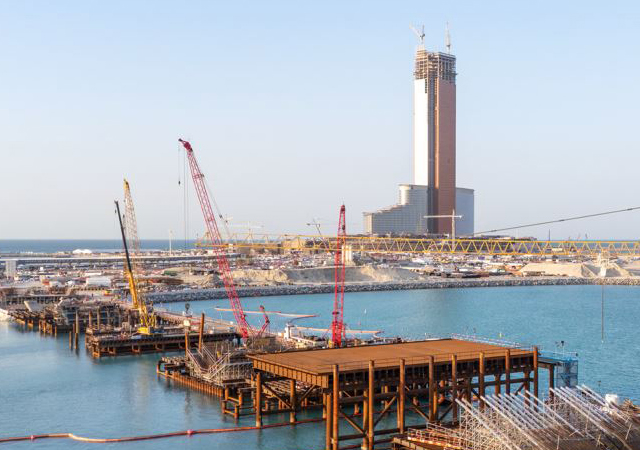


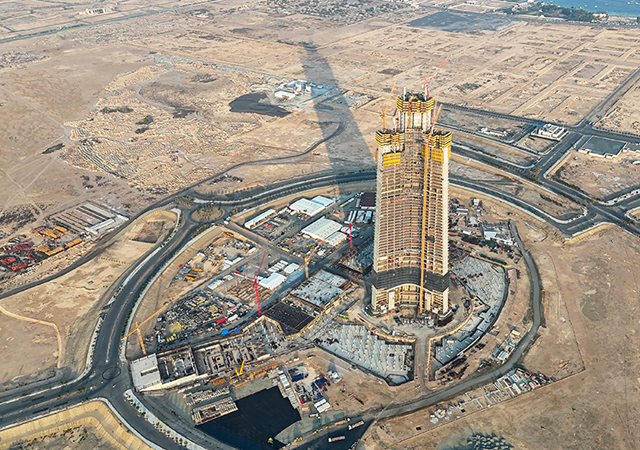
Jeddah Tower is now making a steady rise to reach its designed height of more than 1,000 m, which will make it the world’s tallest tower on its targeted completion in 2028.
The project is being developed by Jeddah Economic Company (JEC), a subsidiary of Kingdom Holding Company (KHC) – a Saudi conglomerate with interests in key sectors such as hotel management, real estate and equity.
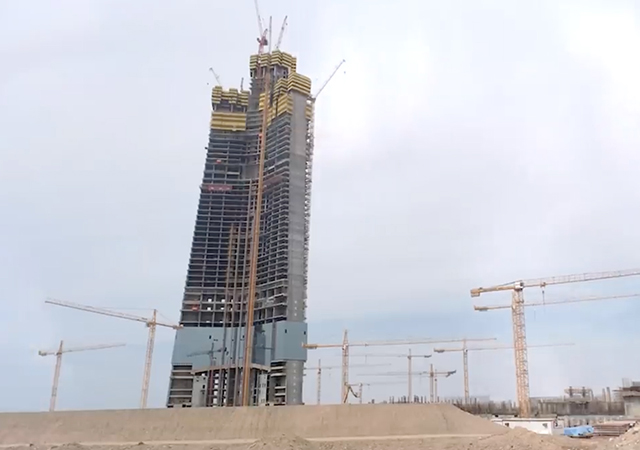
According to Talal Ibrahim Almaiman, CEO of Kingdom Holding Company, the structure has already reached 74 floors.
“As the flagship asset of our land portfolio, the JEC Tower continues to show excellent progress,” he said in the third quarter 2025 financial statement released last month (November)
“We are targeting a five-to-six-day construction cycle per floor across all sections by the end of 2025,” Almaiman stated.
Jeddah Tower (previously known as Kingdom Tower) is located along the Red Sea on the north side of Saudi port city.
 |
|
Jeddah Tower is targeted for completion in 2028. |
Construction work on the skyscraper resumed in January this year following the reappointment of Saudi Binladin Group (SBG) as the main contractor under a contract valued at SR7.2 billion ($1.96 billion). Of this, around SR1.1 billion has been already paid to SBG for works previously completed on the tower.
Construction work on the Jeddah Tower had initially begun in 2009 with SBG serving as the contractor for the superstructure and was paused in 2018 due to an anti-corruption crackdown in Saudi Arabia. The initial phase saw approximately one-third of the superstructure complete, reaching a height of 63 floors.
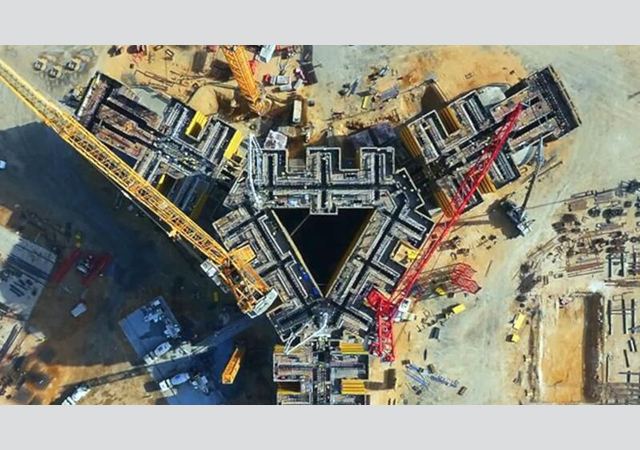
According to a video released by Unimaginable Builds, fresh drone footage from late 2025 shows the tower rising past 75 floors, with the central core advancing at a pace of one floor every three to four days. Cladding installation has begun, and the building’s tri-petal footprint – engineered to mitigate extreme wind loads – is clearly visible.
According to the report, the project involves engineering methods unprecedented in supertall construction. The tower sits on 270 reinforced concrete piles, some driven 110 m into the ground, each capable of supporting roughly 3,000 tonnes.
 |
|
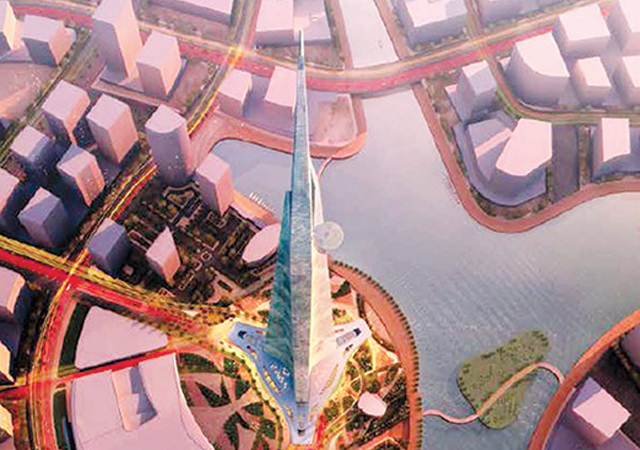
The three-petal footprint arranged in a Y-shape was designed for aerodynamic efficiency. |
The structure will rely on specially formulated high-strength concrete designed to withstand the coastal corrosion experienced in the Jeddah area and pumped vertically more than 600 m under extreme pressure. Engineers are also managing “differential shortening”, a phenomenon where the tower’s core could shrink by as much as 25 cm during curing, necessitating complex outrigger and belt-wall systems to maintain structural alignment.
The building’s upper spire, redesigned to host communications systems and withstand hurricane-level forces, is expected to face accelerations strong enough to cause motion sickness during storms.
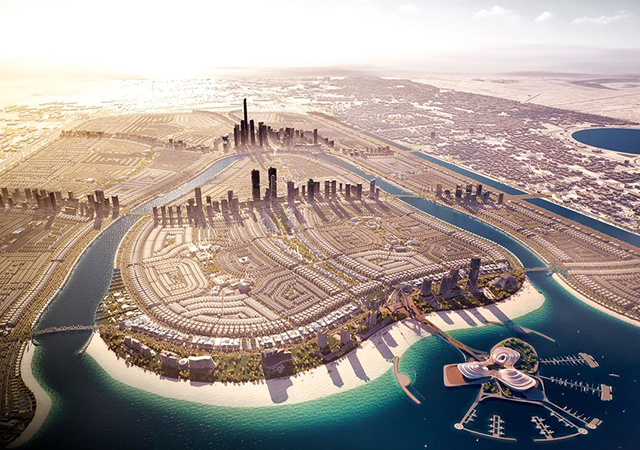
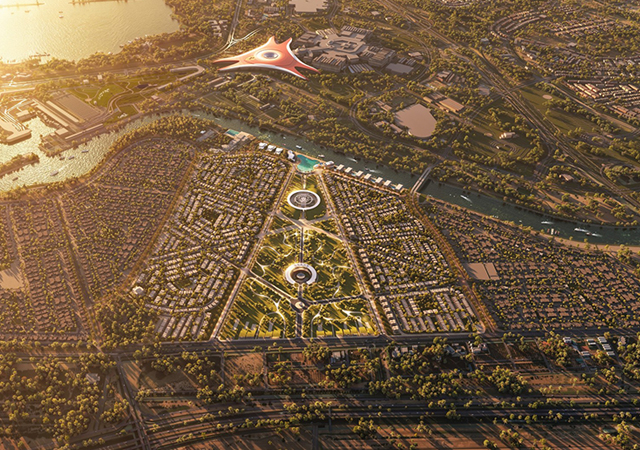
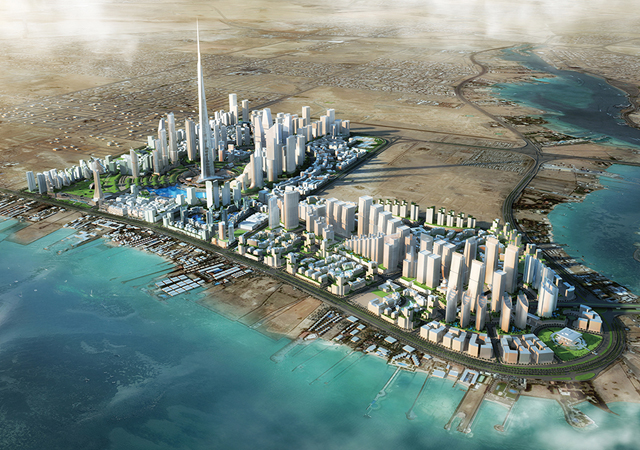
Unimaginable Builds said the resumption is tied closely to Saudi Arabia’s Vision 2030 economic diversification agenda. The tower anchors the wider $20-billion Jeddah Economic City development, intended to transform the kingdom’s Red Sea coast into a commercial hub.
The project’s true cost may far exceed original estimates. Construction insiders cited in the report suggest the final figure could approach $26 billion when factoring in delays, design modifications and inflation.
The project faces significant technical and operational risks, the report says. Water delivery to upper floors will require multi-stage pumping stations embedded throughout the tower. Fire safety planning includes refuge floors every 25 storeys, as no firefighting equipment globally can reach above 100 m. Maintenance systems will include custom-built automated façade equipment capable of operating in high-wind conditions that would normally ground aircraft,
 |
|
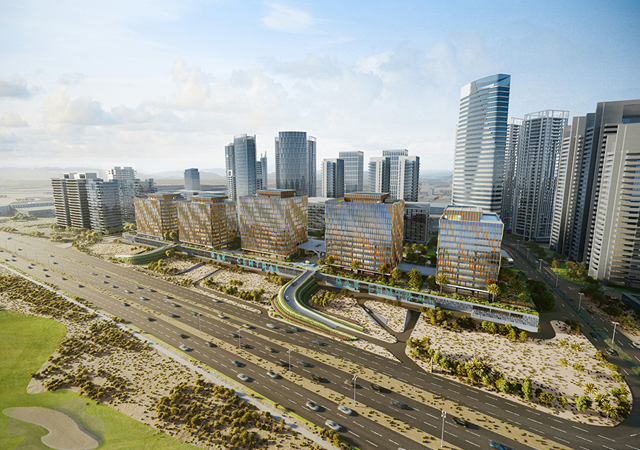
Jeddah Tower anchors the wider $20-billion Jeddah Economic City development. |
Unimaginable Builds states that approximately 5,000 workers are currently employed on-site, with a further 2,000 required for operations once the tower opens. The report places the building’s most optimistic completion target at 2028, though 2030 is seen as more realistic given previous delays. Completion by then would align with the milestones of Vision 2030, offering the kingdom a new global landmark and a symbol of its economic ambitions.
The building was designed by US-based Adrian Smith + Gordon Gill Architecture (AS+GG).
Commenting on work under way on site, Architect Robert Forest, a partner at AS+GG, told Newsweek: “Construction activities have ramped up, and the atmosphere on site is robust. The entire team is committed and focused on realising this iconic structure for the Kingdom of Saudi Arabia.”
Dar Al-Handasah (Shair & Partners) is providing engineering support while Turner Project Management is the project manager.
Functionally, Jeddah Tower will serve as a mixed-use complex, incorporating residential, commercial, and office spaces. Once complete, the tower is expected to include a Four Seasons hotel, 325 luxury residences and what would become the world’s highest commercial office floors. Additionally, plans include an observation deck, set to become the world’s tallest, and a sprawling outdoor balcony originally designed as a helipad.
 |
|
Jeddah Tower will be served by 59 elevators. |
Jeddah Tower’s design is both highly technological and distinctly organic. With its slender, subtly asymmetrical massing, the tower evokes a bundle of leaves shooting up from the ground – a burst of new life that heralds more growth all around it.
The project will feature a high-performance exterior wall system that will minimise energy consumption by reducing thermal loads. In addition, each of Jeddah Tower’s three sides features a series of notches that create pockets of shadow that shield areas of the building from the sun and provide outdoor terraces with stunning views of Jeddah and the Red Sea, according to the designer.
The great height of Jeddah Tower necessitates one of the world’s most sophisticated elevator systems, which will be supplied by Finland-based KONE, a global leader in elevators and escalators. The Jeddah Tower complex will be served by 59 elevators, including 54 single-deck and five double-deck elevators, along with 12 escalators. Elevators serving the observatory will travel at a rate of 10 m/sec in both directions.
According to KONE, Jeddah Tower will feature the world’s tallest elevator ride enabled by KONE’s innovative UltraRope, a pioneering, super-light hoisting technology designed specifically for the demands of high-rise and supertall buildings. To ensure smooth People Flow in this iconic building, KONE will deliver a total of 67 elevators and escalators including 29 KONE MiniSpace elevators with a speed of up to 10 m/s, seven KONE MiniSpace DoubleDeck elevators and two KONE JumpLift construction time elevators.
Additionally, the order includes 21 KONE MonoSpace elevators, eight KONE TravelMaster 110 Escalators as well as KONE Destination Control System, KONE 24/7 Connect and KONE E-Link remote monitoring. The order also includes two years of maintenance.
“With a carbon fibre core and high-friction coating, UltraRope offers a unique combination of high performance, reliability, and energy efficiency. It enables unprecedented travel heights of up to 1 km, overcoming the limitations of conventional steel ropes by significantly reducing moving masses,” says a spokesperson for KONE.
“This not only enhances ride comfort and system efficiency but also helps cut energy consumption by up to 15 per cent on the over 630-m vertical voyage to the world’s highest observation deck,” he adds.