































































Industrial AI software provider IFS and professional services network PwC UK have jointly published a whitepaper calling on heavy, asset-intensive industries to rapidly adopt Industrial AI to achieve decarbonisation targets and boost efficiency.
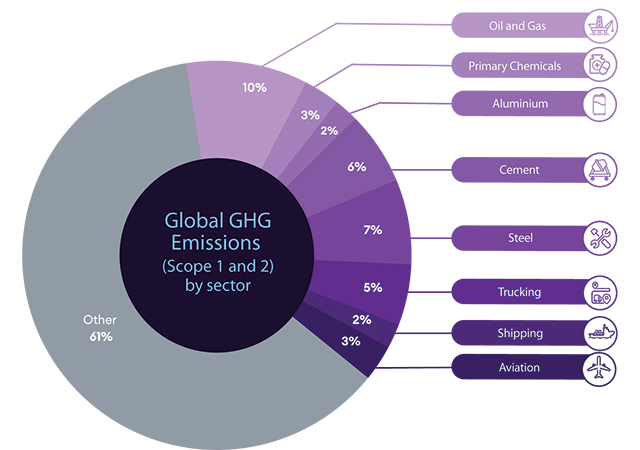
The report, titled “The Intelligence Behind Sustainability: Industrial AI’s Critical Role in Decarbonization,” arrives as eight hard-to-abate sectors – including aviation, shipping, steel, cement, and oil and gas – account for approximately 40 per cent of total global greenhouse gas (GHG) emissions.
The whitepaper calls on the industrial world to leverage Industrial AI to improve sustainability and operational efficiency, supporting measurable emissions reductions across heavy and hard-to-abate sectors.
With every new furnace or turbine built today risking locked-in emissions until mid-century, the need for intelligent optimisation of existing assets, as well as transition to new operating models, has never been more urgent.
Drawing on IFS’s research, “The Invisible Revolution” (2025), which surveyed more than 1,700 senior executives globally across manufacturing, energy, construction, and utilities, the report reveals that industrial AI adoption is accelerating rapidly and 86 per cent believe AI will help organisations meet environmental goals from energy efficiency and emissions reporting to CO₂ management.
 |
|
Sophie Graham, Chief Sustainability Officer |
Industrial AI is already delivering measurable results. The report documents how AI-driven solutions are cutting emissions and costs across multiple applications:
• Field service routes optimisation reducing travel distance by an average of 37 per cent, delivering measurable efficiency gains and supporting emissions reduction efforts, according to IFS field service data.
• AI-driven scheduling can support reductions in Scope 2 emissions by up to 47.6 per cent by aligning production with periods of lower grid carbon intensity.
• Predictive maintenance is extending asset life, reducing embodied carbon, and preventing energy waste from equipment failures.
“We’re seeing Industrial AI fundamentally change how organisations approach sustainability,” says Sophie Graham, Chief Sustainability Officer at IFS. “Our customers are using AI to optimise everything from field service routes to production scheduling, and the results are tangible: less waste, lower emissions, and stronger operational performance. At IFS, we’re committed to deploying AI solutions that help our customers achieve their sustainability goals while building more resilient, competitive operations.”
“AI holds transformative potential for industrial and hard-to-abate sectors, guiding us towards net zero outcomes with innovative precision. However, as AI-driven solutions illuminate our path, we must also manage their energy demand responsibly. Harnessing this dual opportunity to lead with sustainability and efficiency will be at the forefront of industry evolution,” says Leigh Bates, Partner at PwC.
 |
|
Source: IEA and IAl. via World Economic Forum: Net-Zero Industry Tracker 2024 Edition |
THREE PATHWAYS TO SUSTAINABILITY IMPACT
The report identifies three key ways industrial AI intersects with sustainability. First, it enables industrial organisations to “do more with less” by optimising resource use and reducing waste across operations. Second, it allows companies to leverage data for insights, creating traceable, auditable information that verifies sustainability results and supports decision-making. Third, it delivers business model transformation by enabling outcome-based and circular economy models through digital twins and AI-driven decision analytics platforms that help organisations test long-term investment portfolios against climate scenarios.
ADDRESSING THE AI ENERGY PARADOX
While acknowledging that AI adoption comes with increased energy demand, the report emphasises the net positive impact when responsibly deployed. According to the Grantham Research Institute on Climate Change and the Environment and Systemiq, advancements in AI in power, transport, and food consumption could reduce global greenhouse gas emissions by 3.2 billion to 5.4 billion tonnes of carbon-dioxide-equivalent annually by 2035.
The report calls for a balanced approach that includes renewable energy sourcing, carbon-aware scheduling, edge computing, and strong governance over data quality and validation to ensure AI’s energy use doesn’t erode the gains it delivers.
A critical finding highlighted in the report is Industrial AI’s unique role in creating traceable, auditable data across operations. This capability addresses the growing demand for measurable, verifiable decarbonisation progress from regulators, investors, and customers seeking to decarbonise their value chains.
The report concludes that organisations must start with measurable use cases like predictive maintenance, scheduling optimisation, and process control that deliver fast returns. Success requires investing in data readiness to ensure clean, connected data supports scalability, while embedding trust early through governance, secure infrastructure, and sustainable compute practices.
Industrial AI is actively transforming operations today. The organisations embracing it first will lead the next era of sustainable industry.
The full report, “The Intelligence Behind Sustainability: Industrial AI’s Critical Role in Decarbonization,” is available for download at https://www.ifs.com/assets/corporate/industrial-ai-critical-role-in-decarbonization.