






































































Japanese researchers have unveiled a new digital framework that could significantly reshape how bridges are inspected, maintained and repaired worldwide, as governments grapple with ageing road and bridge networks and mounting maintenance backlogs.
The digital framework could support Gulf countries’ ambitions to improve the resilience and lifecycle performance of road and bridge assets, as transport authorities across the region invest heavily in digital twins and predictive maintenance under long-term national development strategies.
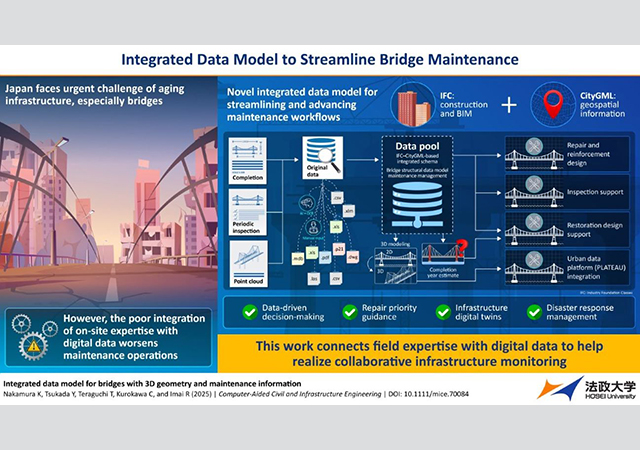
The study, led by Hosei University in Tokyo, proposes an integrated data model that combines 3D bridge geometry with inspection and maintenance records such as inspection records and repair history into a single digital environment. The approach addresses a long-standing challenge in infrastructure management, where critical information is fragmented across siloed systems, limiting effective decision-making and management.
The research, published in November 2025 in the journal Computer-Aided Civil and Infrastructure Engineering, merges two widely used international standards – Industry Foundation Classes (IFC), which underpins building information modelling (BIM), and CityGML, a global standard for geospatial data. The result is a unified, “one-source” digital model that allows engineers and asset managers to visualise damage, track repair histories and plan interventions directly on a 3D representation of a bridge.
Researchers say the approach could have far-reaching implications for road and bridge maintenance programmes globally, particularly in regions where large portions of transport infrastructure are reaching the end of their design life.

The integrated model aims to streamline inspection, diagnosis and repair planning, while also laying the groundwork for digital twins of bridge assets.
“Our work would allow infrastructure managers, specifically local governments, to accurately grasp damage locations found during inspections and past repair histories for the numerous bridges under their jurisdiction, all visualised on 3D models,” said Professor Ryuichi Imai of Hosei University, who led the study. “For example, they can instantly check information – either on-site or in the office – like, ‘Is this damage located in the same spot that was repaired 5 years ago?’ This enables them to make precise, data-driven decisions about repair priorities and the most suitable repair methods. This is expected to lead to improved infrastructure safety and longevity and efficient use of public funds.”
The challenge is acute in Japan, where thousands of bridges were built during the country’s post-war economic boom and are now ageing simultaneously. However, the problem is mirrored across Europe, North America, the Middle East and parts of Asia, where road authorities face rising inspection costs, skills shortages and increasing pressure to prevent high-profile structural failures.
Globally, bridge maintenance data is often fragmented, with inspection reports, repair histories and design information stored in separate systems or formats. This makes it difficult to link field observations with historical data, limiting the ability of engineers to assess risks or optimise maintenance spending.
The integrated model developed by the Japanese team aims to streamline inspection, diagnosis and repair planning, while also laying the groundwork for digital twins of bridge assets. Such digital replicas would allow authorities to simulate deterioration over time and shift from reactive maintenance to predictive, condition-based interventions.
According to the researchers, widespread adoption of the model over the next five to 10 years could enable artificial intelligence-driven forecasting of structural performance, helping asset owners intervene before defects escalate into safety-critical failures.
This would accelerate the shift from reactive maintenance to predictive maintenance.
For road and bridge maintenance contractors, the approach could also change how projects are scoped and delivered, with greater reliance on data-driven assessments and lifecycle planning rather than isolated repair works.
The study was conducted as part of Japan’s Strategic Innovation Promotion (SIP) programme for smart infrastructure management and involved researchers from multiple universities and industry partners.
Beyond routine maintenance, the model could also support emergency response, enabling authorities to quickly assess which bridges remain passable after earthquakes, floods or other disasters, the researchers said.
While developed in a Japanese context, the framework is based on international standards, making it readily transferable to other markets.