







































When a bridge, hospital, metro line, or highway exceeds its budget, public frustration is understandable. “Where did the money go?” is the question that follows almost every major overrun.
The answer is rarely simple, and rarely sinister.
Cost overruns are frequently read as evidence of corruption or mismanagement, and such issues do occur and deserve scrutiny wherever credible evidence exists. But that reading does not explain most of what actually happens on a live construction site. Across 16 years of managing costs, contracts, and claims on major projects in the GCC, I have seen a different and far more common explanation for the majority of overruns: the legitimate technical, contractual, commercial, and economic pressures that emerge once a project leaves the drawing board.
This article explains those pressures from a quantity surveyor’s vantage point – not to excuse waste, but to help readers tell the difference between avoidable failure and the ordinary cost of building something large in the real world.
Public infrastructure, whether funded by taxpayers, sovereign wealth, or private capital, deserves transparent scrutiny; understanding where overruns genuinely come from is a precondition for that scrutiny being useful rather than simply adversarial.
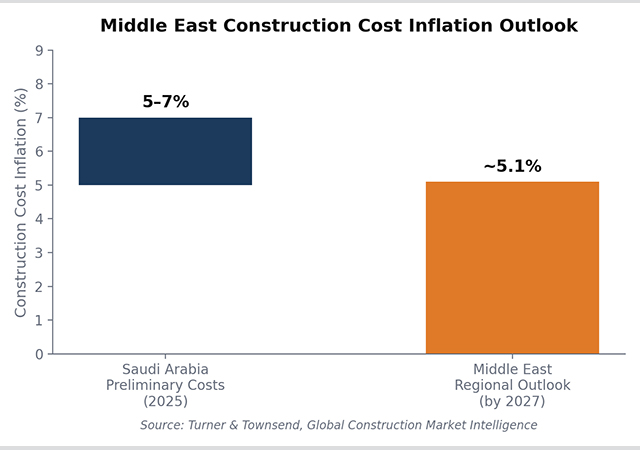
Figure 1 - Middle East construction cost inflation outlook
The estimate is a forecast, not a guarantee
Every construction project begins with an estimate, built from available design drawings, quantity take-offs, market prices, productivity assumptions, and a schedule. These estimates are prepared carefully, but they remain forecasts, not guarantees. At the planning stage, many important details – ground conditions, final specifications, procurement lead times – are still unknown, and the budget reflects the best information available at the time, not the complete picture.
When assumptions meet the ground
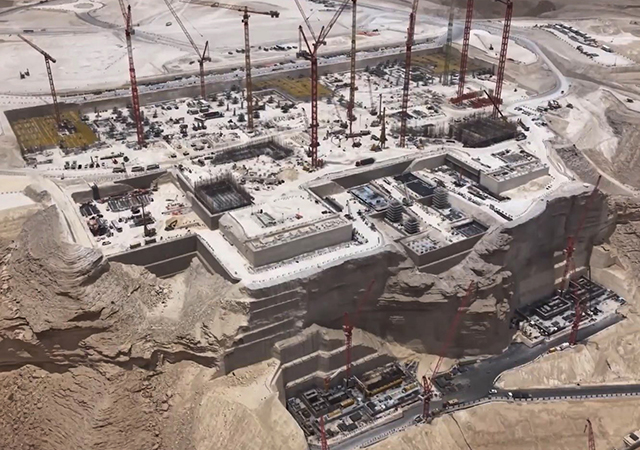
As construction progresses, reality replaces assumption. Clients revise designs to improve functionality or aesthetics. Engineers encounter unexpected ground conditions – poor soil, hidden utilities, difficult site access – that were never visible in the original survey. Each of these triggers additional work, and additional work means additional time and cost.
On a building package I worked on, the original geotechnical survey classified the founding strata as soft rock. Once excavation began, the actual ground turned out to be hard rock, requiring a change in excavation method and foundation design that was never priced into the original bill of quantities. The variation added an estimated 31 per cent to that section’s cost and around eight weeks to the programme, entirely attributable to ground conditions that no amount of desk-based design could have fully predicted.
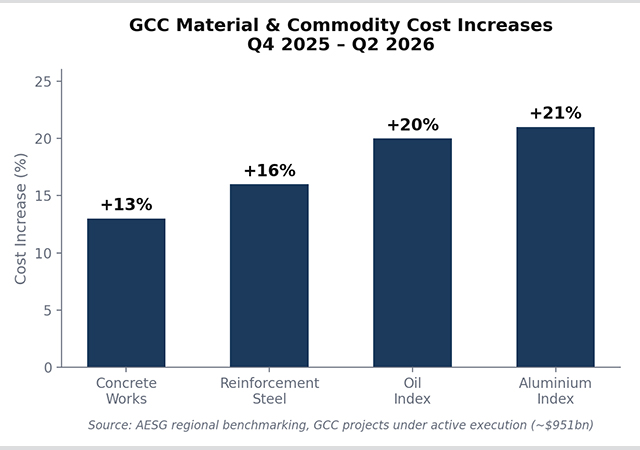
Figure 2 - GCC Material and commodity cost increases
Market volatility: why the GCC feels it differently
Large infrastructure projects often run for several years, during which the prices of steel, cement, fuel, and labour can move considerably – even when the scope of the project never changes. This is not a hypothetical risk in the Gulf; it is a current one. Turner & Townsend’s Global Construction Market Intelligence report projects Middle East construction cost inflation rising to roughly 5.1 per cent by 2027, with Saudi Arabia’s preliminary costs alone expected to have climbed five to seven per cent in 2025 on the back of strong demand for steel, cement, and concrete against constrained supply (Figure 1).
More recent regional benchmarking tells the same story at a sharper resolution. Engineering consultancy AESG reported that concrete works and reinforcement steel costs rose 13 per cent and 16 per cent respectively across the GCC between the fourth quarter of 2025 and the second quarter of 2026, against a backdrop of roughly $951 billion in projects under active execution. Its underlying commodity data showed oil and aluminium indices up 20 per cent and 21 per cent over the same period (Figure 2).
None of this reflects a single project’s mismanagement – it reflects a regional market where demand for materials is surpassing supply.
Scope creep and cumulative weight of variations
Project scope itself tends to evolve. Additional facilities, revised specifications, tightened safety requirements, or regulatory changes frequently surface after construction has begun. In quantity surveying, these changes are known as variations – any addition, omission, or modification to the contracted work after signature. Variations often trigger contractor claims for extra work, extended duration, higher material costs, and prolonged site overheads. Individually, each may be entirely justified.
Collectively, across a large programme, they become one of the leading causes of budget overruns; global research places the picture starkly, with studies finding that roughly 90 per cent of large infrastructure projects worldwide exceed budget, by an average of around 28 per cent.
Distinguishing a legitimate variation from genuine mismanagement requires an understanding how these costs actually arise.
On a sports academy building package, a client-instructed bundle of variations covering cladding, MEP adjustments and finishing items was first submitted at a net additional cost of roughly RO315.6. After re-measurement against the varied scope and a review of rates and quantities, the agreed net figure came down to RO207.7 – a reduction of close to a third from the initial submission.
It is a small example, but typical of what happens on almost every variation: the number a contractor first submits and the number a quantity surveyor eventually certifies are rarely the same.
The price of time
Time itself is a cost driver. Every day of delay carries a financial consequence: extended labour and equipment rental costs, prolonged site management, insurance, financing charges, and administrative overheads. In the GCC, where several giga-programmes are tied to fixed, externally imposed deadlines, for instance, the Expo 2030 in Riyadh and the 2034 FIFA World Cup, the pressure runs in an unusual direction: rather than schedules slipping quietly, programmes are compressed and awarded before design and scope are fully settled, which shifts risk onto the construction phase itself and increases the likelihood of variations later.
Why the Gulf market is a distinct case
Three regional features make GCC cost overruns different in character from those elsewhere, and worth treating as a category of their own rather than a local variant of a global problem.
Financing structures: Many mega-projects are funded through sovereign vehicles or public–private partnerships with milestone-linked drawdowns. When a funding milestone slips even slightly, contractors can face cash-flow pressure well before any physical work is affected, which, in turn, feeds into claims and pricing behaviour.
Import dependency: The region imports a large share of its steel, aluminium, and specialist plant, which exposes projects directly to freight costs, shipping route disruption, and currency-linked price swings that have nothing to do with site performance. Regional cost-tracking services such as the Stonehaven Cost Index exist specifically because these swings are frequent enough to need weekly monitoring rather than annual review.
Regulatory and programme shifts tied to national development plans: Vision 2030 in Saudi Arabia and Dubai’s 2040 Urban Master Plan have introduced new codes, sustainability requirements, and localisation rules mid-programme on projects that were tendered years earlier under different rules – a legitimate policy objective that nonetheless lands as a cost variation on live contracts. Labour reforms have had a similar effect: Wage Protection System rules being rolled out across the GCC are estimated to have raised total labour costs by 15 to 20 per cent on expatriate-heavy contracts.
Conclusion: Understanding before judging
Construction projects rarely exceed their budgets because of one isolated error. Overruns result from the interaction of design evolution, changing site conditions, economic volatility, contractual adjustment, and delay and, in the Gulf specifically, from import dependency, milestone-linked financing, and programmes compressed by fixed external deadlines. The original estimate is an informed prediction; the final cost reflects what actually happened on the ground.
None of this is an argument against scrutiny; it is the opposite. Public infrastructure is funded by taxpayers, sovereign wealth, or private capital, and every dirham or riyal spent deserves accountability and transparent reporting. But scrutiny is only useful when it is informed.
Distinguishing a legitimate variation from genuine mismanagement requires an understanding how these costs actually arise. Better planning, stronger risk management, transparent contract administration, and disciplined cost control can reduce financial surprises; they may never eliminate them, but they can ensure that when a project does run over, the public can tell the difference between bad luck, bad management, and the ordinary economics of building at scale.
* Raseen Abdul Rasak is a senior quantity surveyor and construction cost analyst with 16 years of GCC experience in cost management, contract administration, commercial management, claims, and project cost control across major construction projects. He is currently residing and working in Doha, Qatar, and regularly writes on construction economics, project management, and infrastructure cost management to promote better industry practice and public understanding of construction finance.