























































Across the GCC, governments are investing heavily in desalination plants, wastewater treatment facilities, pumping stations, strategic reservoirs, and water transmission networks to support growing populations and long-term water security objectives. These infrastructure delivery programmes are becoming larger, more complex, and increasingly schedule driven.
While these projects are often delivered under demanding schedules, engineering designs continue to evolve throughout the early stages of execution. This frequently creates a difficult challenge for project teams: should construction wait until complete design certainty is achieved, or can progress continue through structured decision-making and controlled risk management?
Traditional project delivery approaches generally favour complete design development before construction begins. While this approach minimises uncertainty, it can significantly delay site activities and create downstream schedule impacts on programme-critical milestones.

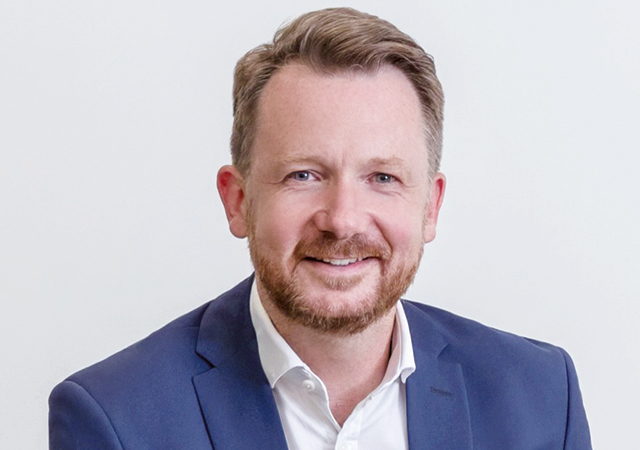
Qureshi ...infrastructure delivery programmes are becoming larger, more complex, and increasingly schedule driven.
Modern infrastructure projects frequently require a different approach. Project teams must determine which elements of the design are truly critical for immediate construction and which can continue to evolve without affecting near-term execution.
The challenge, therefore, becomes not how to eliminate uncertainty altogether, but how to manage it responsibly while maintaining progress.
A common GCC delivery challenge
The issue is not unique to any single project. Throughout the GCC, fast-track infrastructure programmes regularly face situations where schedule-critical works depend on engineering information that is still under development.
Large-scale projects often involve:
• Multi-disciplinary design interfaces;
• International design and construction teams;
• Evolving operational requirements;
• Accelerated procurement
programmes;
• Multiple stakeholder approvals; and
• Overlapping design and construction phases.
Under such conditions, waiting for complete design maturity before releasing all construction activities can introduce substantial schedule risk.
Instead, project teams increasingly rely on structured decision-making frameworks that distinguish between manageable uncertainty and genuine project risk.
The following framework was applied during the delivery of a major water infrastructure project involving a large process structure supported by an extensive piled foundation system.
The structure represented a critical component of the overall facility and formed part of the project’s schedule-critical path. Delaying foundation activities until every design interface reached complete maturity would have resulted in significant programme impacts.
At the time construction planning commenced, certain process and equipment interfaces remained under development. Although the overall design philosophy was established, portions of the final operational loading criteria continued to be refined.
The project team, therefore, evaluated whether selected foundation works could proceed safely using available engineering information while allowing the remaining design development activities to continue in parallel.
The risk-based decision framework
A structured methodology was adopted to support informed decision-making on the water infrastructure project..
Step 1: Identify design dependencies
The multidisciplinary team first mapped all design interfaces affecting the foundation system and categorised them according to potential impact.
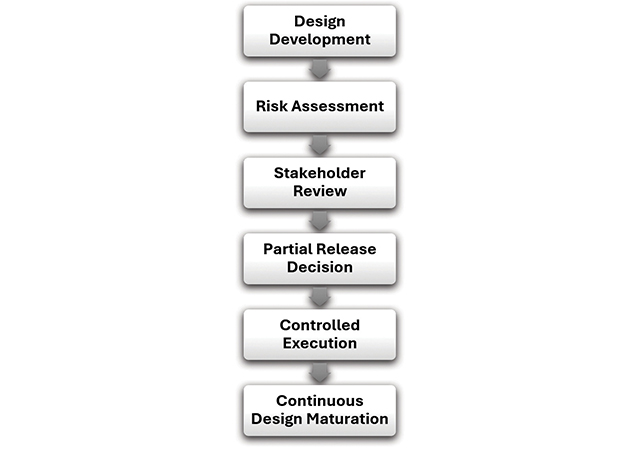
Risk-based decision framework illustrating the structured process used to balance design.
The objective was to distinguish between information that was required immediately for construction execution and that which could be finalised later without affecting completed works.
This exercise enabled the team to isolate areas where uncertainty genuinely affected structural performance from areas where the impact was negligible.
Step 2: Perform engineering impact assessments
Detailed engineering evaluations were conducted to assess the influence of potential future design modifications.
Multiple loading scenarios were reviewed, considering both current design information and reasonably foreseeable revisions. The analysis demonstrated that substantial portions of the foundation system could proceed without introducing unacceptable technical risk.
Step 3: Align stakeholders
Risk assessments alone are insufficient. Infrastructure projects require alignment among owners, consultants, contractors, and discipline specialists.
Accordingly, engineering findings were reviewed collectively to ensure all stakeholders understood:
• The basis of the decision;
• Assumptions used in the evaluation;
• Residual risks;
• Mitigation measures; and
• Monitoring requirements.
This process transformed technical conclusions into project-level decisions supported by transparent governance.
Step 4: Implement controlled release
Instead of a full construction release, activities were authorised in phases. Only construction packages supported by robust engineering justification were permitted to proceed. This approach provided schedule benefits while maintaining control over unresolved design elements.
Step 5: Continue design maturation
Design development did not stop once construction commenced. Continuous monitoring, design reviews, and interdisciplinary coordination ensured that subsequent engineering refinements remained compatible with completed works.
The result was a dynamic process that balanced construction progress with technical assurance.
Framework summary: Five steps for managing design uncertainty
Projects facing similar challenges may consider the following approach:
• Identify critical design dependencies.
• Separate high-risk and low-risk work fronts.
• Conduct multidisciplinary impact assessments.
• Release construction packages in phases.
• Continuously monitor design evolution and project risk.
This framework helps organisations maintain momentum while preserving engineering integrity and governance.
Five questions before releasing construction under design uncertainty
• Are the key load paths sufficiently defined?
• Have potential future design changes been assessed?
• Is the residual risk acceptable?
• Have all stakeholders endorsed the decision?
• Is there a mechanism for monitoring future design evolution?
A positive response to these questions provides a stronger basis for phased construction release and critical-path protection.
Key lessons for project leaders
Successful megaprojects are not delivered by waiting for complete certainty. They are delivered by distinguishing between uncertainties that can be managed and risks that must be mitigated.
Several important lessons emerged from the experience:
Uncertainty does not always equal risk: Project teams often treat uncertainty and risk as identical concepts. In reality, many design uncertainties have little or no impact on immediate construction activities. Identifying this distinction creates opportunities to maintain progress without compromising quality or safety.
Data should drive decisions: Schedule acceleration must never rely solely on judgment or optimism. Engineering analyses, quantified assessments, and documented evaluations provide the foundation for responsible decision-making.
Stakeholder alignment is critical: Many schedule delays arise not from technical limitations but from uncertainty among stakeholders.
Transparent communication and collaborative reviews often play a more important role than engineering calculations alone.
Phased releases can protect the critical path: Rather than adopting an all-or-nothing approach, phased execution strategies allow projects to advance while retaining flexibility for ongoing design development.
Why this matters for GCC projects
As GCC countries continue investing in water security and environmental infrastructure, project teams face increasing pressure to accelerate delivery while maintaining rigorous engineering standards. Similar challenges arise across desalination plants, wastewater treatment facilities, pumping stations, strategic water storage facilities, utility and transmission networks, and industrial water infrastructure.
These projects frequently involve distributed stakeholders, multiple design centres, overlapping project phases, and demanding completion schedules. In such environments, the ability to distinguish between critical and non-critical design uncertainty becomes a key project management capability.
Organisations that can make structured, evidence-based decisions under controlled uncertainty are often better positioned to protect programme objectives while maintaining technical excellence.
The phased release strategy demonstrated that carefully selected construction packages can proceed safely when supported by quantified engineering assessments and stakeholder alignment. By prioritising mature work fronts, the project team was able to protect critical-path activities while allowing ongoing design development to continue in parallel.
As GCC countries continue expanding water and environmental infrastructure programmes, project teams will increasingly encounter situations where construction schedules outpace design maturity. The ability to evaluate uncertainty systematically, rather than reactively, can help organisations improve delivery performance, reduce programme risk, and maintain engineering governance across complex multi-stakeholder projects.
Conclusion
Successful infrastructure delivery rarely depends on achieving complete design certainty before construction begins.
Instead, success often depends on an organisation’s ability to understand which uncertainties can be responsibly managed, and which require resolution before work proceeds.
A disciplined framework incorporating engineering assessment, stakeholder alignment, phased release strategies, and continuous monitoring can protect critical-path activities without compromising safety, quality, or governance.
As GCC nations continue developing the next generation of water and environmental infrastructure assets, the capability to make informed decisions under conditions of controlled uncertainty will remain a defining factor in successful project delivery.
* Kashif Ahmed Qureshi is Assistant General Manager, Civil & Structural Engineering at Tata Consulting Engineers Limited.
(The views expressed in this article are those of the author and are based on professional project experience. They are intended solely for knowledge-sharing purposes and do not necessarily represent the official views or policies of Tata Consulting Engineers.)