







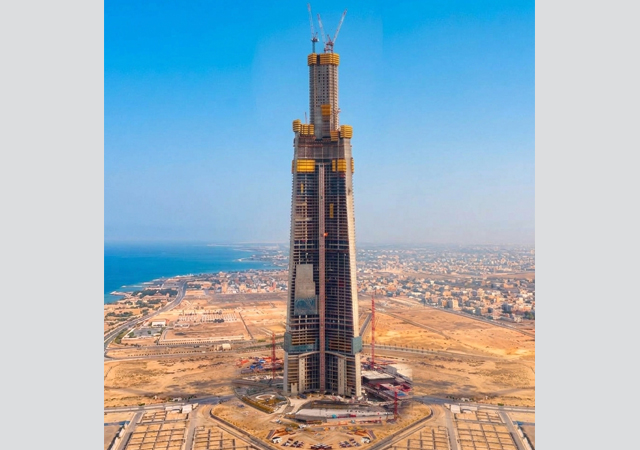
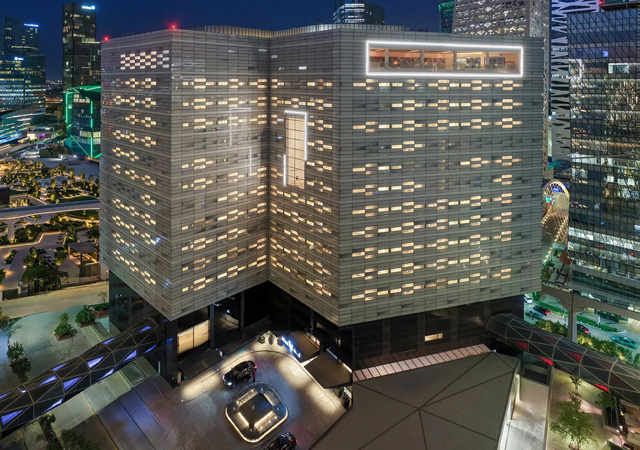



ADNEC’S Capital Gate, which leans 18 degrees westwards, has been certified as the ‘World’s Furthest Leaning Manmade Tower’ by Guinness World Records.
Capital Gate, owned and developed in Abu Dhabi by Adnec (Abu Dhabi National Exhibitions Company), has a lean that is more than four times that of the world famous Leaning Tower of Pisa. It earned this recognition following rigorous evaluation by the Guinness awards committee since January this year, when the exterior of the 160 m (524.9 ft), 35-storey tower was completed.
Capital Gate’s floor plates are stacked vertically up to the 12th storey after which, they are staggered over each other by between 300 mm to 1,400 mm, giving rise to the tower’s dramatic lean.
 |
The tower features other innovative construction techniques including the world’s first known use of a ‘pre-cambered’ core, which contains more than 15,000 cu m of concrete reinforced with 10,000 tonnes of steel. The core, deliberately built slightly off centre, straightens as the building rises, compressing the concrete and giving it strength, and moving into (vertical) position as the weight of the floors has been added.
When fully complete by the end of this year, Capital Gate will house the five-star Hyatt Capital Gate hotel as well as approximately 20,000 sq m of premium office space.
Capital Gate was designed by international architecture firm RMJM and is adjacent to the Abu Dhabi National Exhibition Centre within Adnec’s Capital Centre.
The tower has other elements that enhance its reputation as one of the world’s most distinctive projects: each room is different as is each pane of façade glass and every interior angle. The tower’s shell comprises a super-strong exo-skeleton called the diagrid that carries all the weight of the floors while also providing an unobstructed floor plate precluding the need for pillars or internal beams. A double-glazed façade achieve greater energy efficiency with waste air being pre-cooled between the inner and outer façades, before being expelled. The façade glass has low emission and has been used in the UAE for the first time, keeping the building’s interior cool and eliminating glare, while maintaining transparency.