













Tourism Development and Investment Company (TDIC), master-developer of major tourism, cultural and residential destinations in Abu Dhabi, has awarded the main construction contract of the Louvre Abu Dhabi to an Arabtec-led joint venture with Constructora San Jose and Oger Abu Dhabi following a competitive tendering process.
The contract, valued at Dh2.4 billion ($653.06 million), signifies a major milestone in the progress of the Louvre Abu Dhabi, a world-class fine arts museum set to open in Abu Dhabi’s Saadiyat Cultural District in 2015.
Sheikh Sultan bin Tahnoon Al Nahyan, chairman of Abu Dhabi Tourism and Culture Authority (TCA Abu Dhabi) and TDIC, stated: “The awarding of this contract confirms Abu Dhabi’s commitment to developing iconic museums in the Saadiyat Cultural District, in line with the vision of HH Sheikh Khalifa bin Zayed Al Nahyan, President of the UAE, and the direction of HH General Sheikh Mohammad Bin Zayed Al Nahyan, Crown Prince of Abu Dhabi and Deputy Supreme Commander of the UAE Armed Forces, aimed at transforming the emirate into a hub of world cultural exchange.”
 |
|
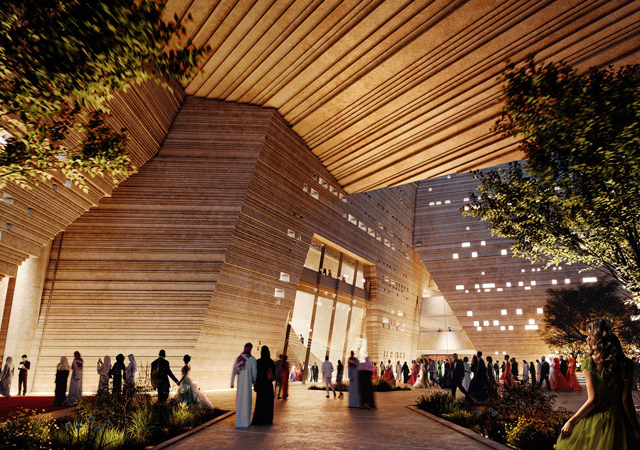
Interior design showing the rain of light effect. |
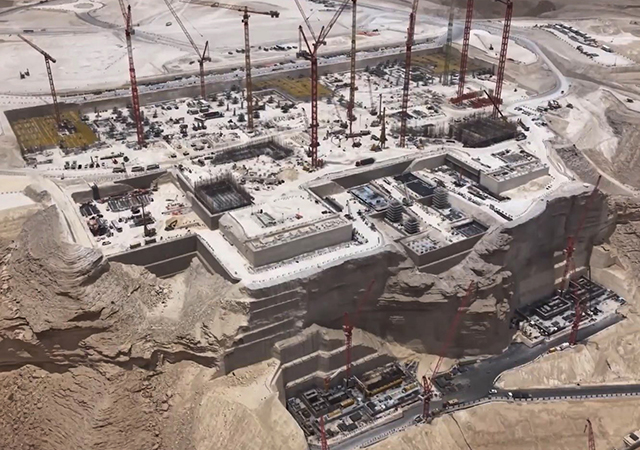
Arabtec and its partners will begin construction works immediately, with the museum’s concrete frame set to be ready by the first quarter of 2014. Work on the geometric lace dome will be completed by the end of 2014. The final stage of the mega project includes marine works and removal of temporary land platforms which will be completed in 2015 when this world-class building transforms into an island of its own.
Arabtec’s managing director Hasan Ismaik stated: “We are extremely proud to have been awarded such a prestigious project and to be contributing to bringing this landmark museum to life with our joint venture partners Constructora San Jose and Oger Abu Dhabi. The Louvre Abu Dhabi is undoubtedly the most anticipated cultural development in the region, and truly reflects the emirate’s ambition to strengthen its position on the global map as a cultural epicentre and leisure lifestyle destination.”
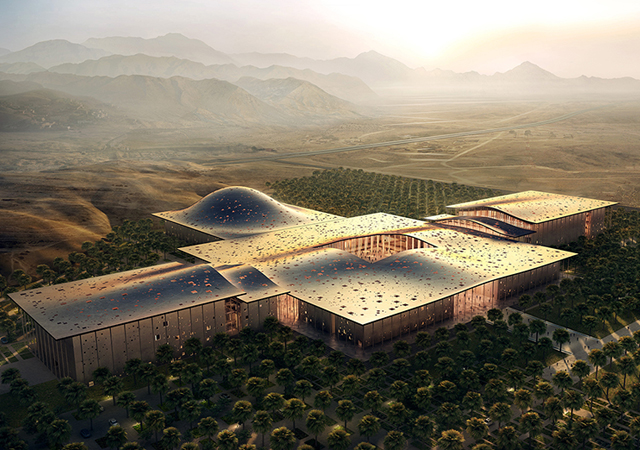
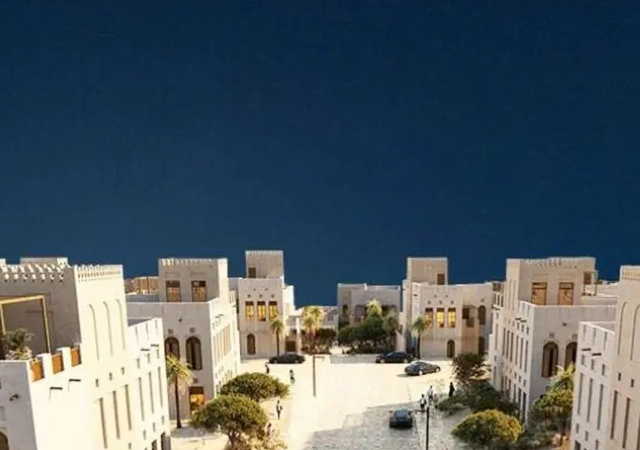
Designed by Pritzker-prize winning architect Jean Nouvel, and with a built-up area of 64,000 sq m, Louvre Abu Dhabi will comprise a complex of pavilions, plazas, alleyways and canals, evoking the image of a city floating on the sea. Hovering over the complex will be a vast shallow dome – some 180 m in diameter – inspired by traditional Arabic architecture and perforated with interlaced patterns allowing diffused light to filter through.
The Louvre Abu Dhabi will encompass 9,200 sq m of art galleries, including a 6,000-sq-m Permanent Gallery and a 2,000-sq-m Temporary Gallery. The museum is developing its own permanent collection, which will be enriched by loans from 12 French museums including Musée du Louvre, Musée d’Orsay, Musée du Quai Branly, and Centre Pompidou.
Acknowledging the challenge of constructing the extraordinary, fluid and beautiful design of the Louvre Abu Dhabi, Ismaik added: “Indeed this project will be a challenge, but a challenge that we cannot wait to conquer.”
The Louvre Abu Dhabi has so far achieved major developmental milestones with the finishing of the building’s detailed design and the completion of the infrastructure, which encompassed marine, excavation, piling and substructure works. A temporary platform in the sea, on which the entire building will be constructed, was built in 2009 to allow all works to take place in a dry environment.
Upon completion of the building including the marine works, the 40-m-high concrete walls currently built in the sand will be removed to allow seawater to flow in gradually. More than 4,000 steel and reinforced concrete piles – a total volume of 21,000 cu m of concrete – were driven into the ground to serve as a base for the Louvre Abu Dhabi building.
The overall structure incorporates passive design techniques and environmental principles. These utilise the natural form of buildings and inherent properties of materials to improve outdoor conditions, such as the solar shading effect of the dome’s roof and self-shading of buildings. The dome was intelligently designed where the roof primarily acts as a shading canopy to protect the outside plaza and building below from the radiant heat of the sun, providing local comfort and reducing building energy consumption. This allows visitors to walk in comfort between the different exhibition spaces.
The Louvre Abu Dhabi will become one of the premier cultural institutions located in the heart of the Saadiyat Cultural District, alongside the Guggenheim Abu Dhabi which will open in 2017, and the Zayed National Museum, slated for completion in 2016.