









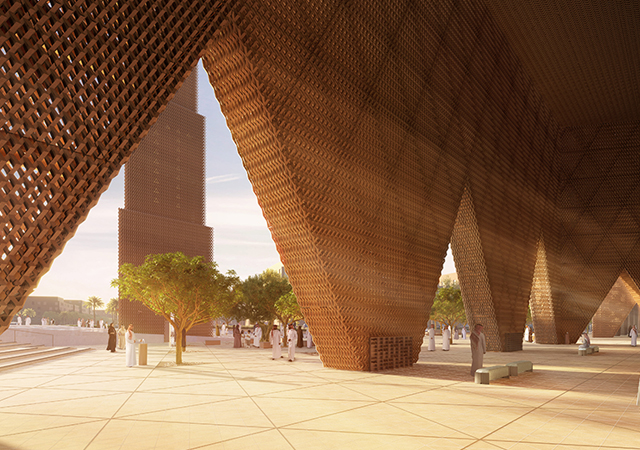
A new architectural icon in Riyadh is closing the gap between ancestral thermal wisdom and modern LEED-standard performance. Located in historic Diriyah, the Grand Mosque project integrates advanced environmental strategies, such as passive cooling and sustainable material sourcing, into a design inspired by traditional mud-brick aesthetics.
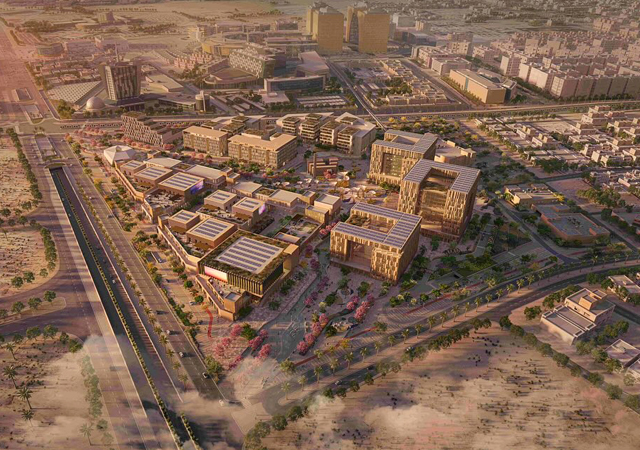
Designed by Dubai-based X Architects, the Grand Mosque at Diriyah Gate II will accommodate up to 11,400 worshippers. The project forms part of the wider transformation of Diriyah – the 300-year-old birthplace of the first Saudi state and a cradle of traditional Najdi mud brick architecture – into a 14-sq-km cultural district comprising museums, civic buildings, residential neighbourhoods and public spaces.
Set at the intersection of Diriyah Gate’s main boulevard and Wadi Hanifah, the mosque occupies a 21,690-sq-m plot with a built-up area of 12,300 sq m. Conceived as more than a place of worship, the scheme integrates daily urban life with ritual practice, reflecting a broader trend in Gulf construction toward multifunctional, socially embedded green buildings.
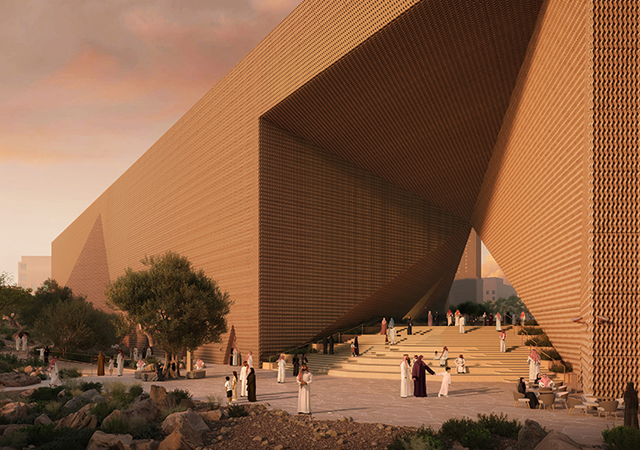
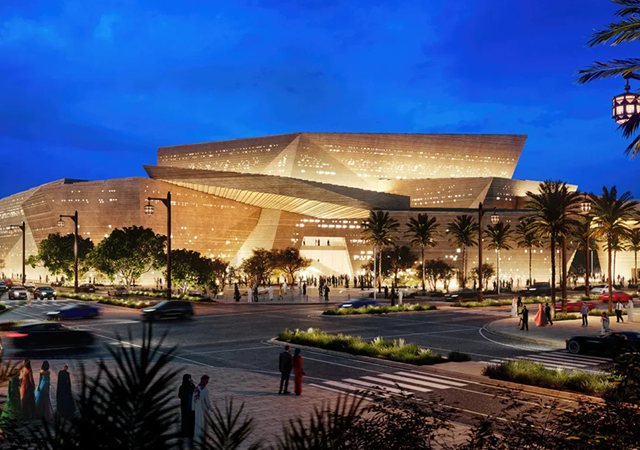
A grand, stepped entrance hall carved from the building volume gathers people beneath a deep triangular portal.
A connector between city and wadi
The site’s defining feature is Wadi Hanifah, a historic valley which cuts across the plot. X Architects’ design merges a major place of worship with the natural landscape, treating the mosque as an intermediate terrain that bridges the urban boulevard and the wadi’s ecological corridor.
A sequence of plazas, shaded passages and landscaped terraces leads worshippers and visitors from the street level down towards the wadi edge, choreographing encounters between the flows of everyday life and moments of contemplation. A grand, stepped entrance hall carved from the building volume gathers people beneath a deep triangular portal, turning arrival into a shared journey of moving from light into shade and back towards the landscape.
The central mosque plaza is designed to host Eid prayers, community gatherings and weekend markets, extending use beyond prescribed prayer times and reinstating the mosque as a social and civic anchor. Around it, colonnaded walkways and planted courts create a porous edge where residents can pass through, pause or stay without crossing a hard threshold between “mosque” and “city”.
“We were interested in how the poetics of everyday movement – arriving from the city, descending towards the wadi, entering into prayer – could be held together in a single spatial sequence. In Diriyah, that sequence becomes a way of restitching the historic valley into the contemporary life of Riyadh,” says X Architects co-founder Ahmed Al Ali.
“There is a tendency to see ‘context’ as either a constraint or a branding device. For us, context is a critical source of design intelligence. The Grand Mosque is shaped by the specific grain of Diriyah – it’s mud brick heritage, the scale of the boulevard, the topography of Wadi Hanifah – and by the very real daily patterns of residents and visitors who will experience this sacred space,” adds co-founder Farid Esmaeil.
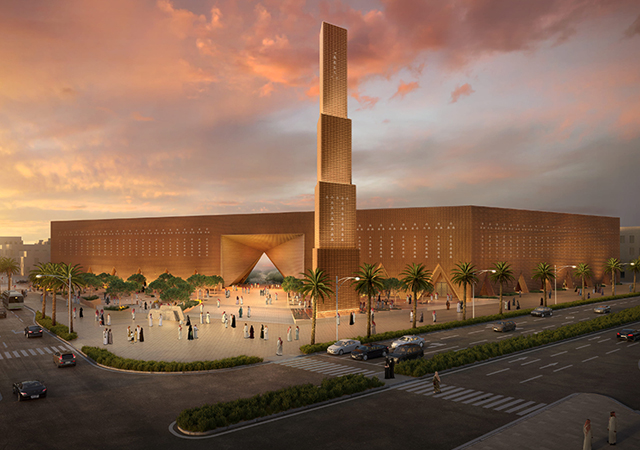
The Grand Mosque at Diriyah Gate II will accommodate up to 11,400 worshippers.
Reinterpreting the Najdi silhouette
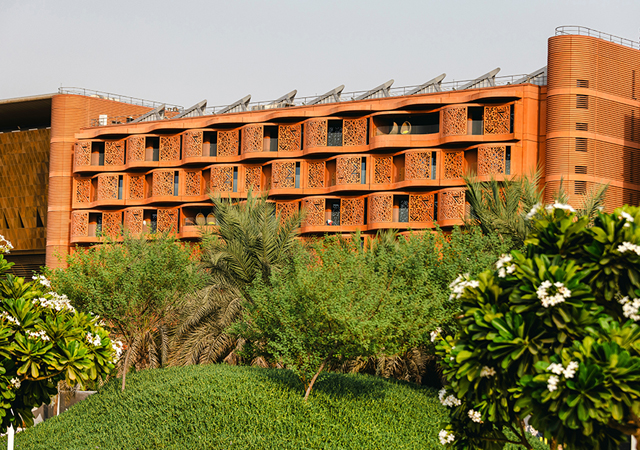
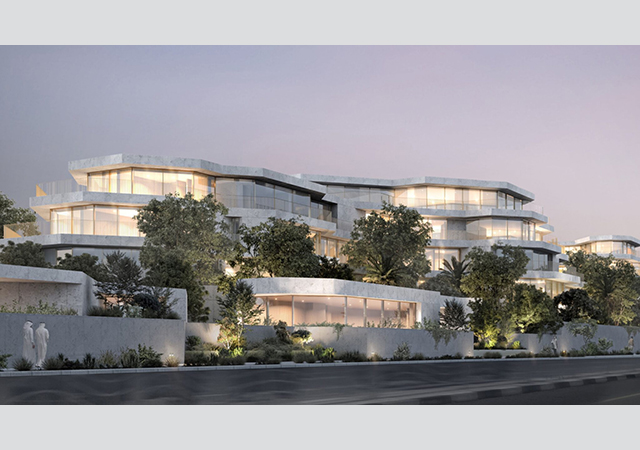
The mosque draws on the clustered forms, thick walls and sculpted parapets of traditional Najdi architecture, translating them into a contemporary, finely textured volume that will be immediately recognisable along the Diriyah boulevard. A continuous, three-dimensional lattice of high-performance prefabricated panels forms double-sided mashrabiya (traditional screens) that wrap the façades. The complex geometries of the lattice form a distinctive skin that recalls hand-made adobe patterns.
Large triangular openings are carved out of this solid perimeter, forming gateways, porches and transition spaces between exterior plazas and the interior sahn (open courtyard). A layered roofscape, deep reveals and rhythmic colonnades echo the profile of historic Diriyah while framing views towards At-Turaif and the wider landscape.
Inside the main prayer halls, the mashrabiya lattice and sloping walls filter light into the prayer lines, reinforcing the orientation towards the qibla and turning the vast interior into a calm, legible space despite its scale. Secondary spaces such as the library, classrooms and women’s areas are treated as private timber-lined rooms opening onto planted courtyards.
Sustainability features are central to the project, aligning with Diriyah Gate II’s broader smart city ambitions. The mosque is targeting LEED and Mostadam Gold certifications, using passive design strategies such as orientation, shading, thermal mass and natural ventilation to reduce energy demand. The façade and roof systems are designed to minimise heat gain while optimising daylight.
The wadi landscape enables a microclimatic design, with planting, water features and topography helping to cool external spaces and extend their usability across more hours of the day.
The adjacent wadi landscape plays a key role in the environmental strategy, enabling a microclimate through vegetation, water features and topographical variation that cools outdoor areas and extends their usability throughout the day – an increasingly important consideration in the Gulf’s harsh climate.
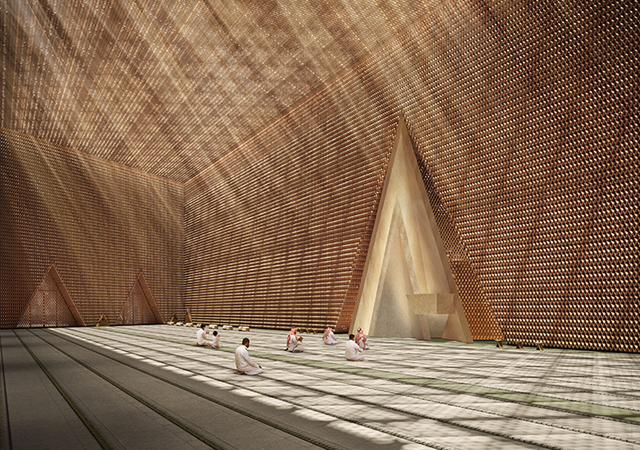
Inside the main prayer halls, the mashrabiya lattice and sloping walls filter light into the prayer lines.
Programmatic richness and accessibility
In line with the Saudi Ministry of Islamic Affairs (MOIA) mosque guidelines, the Grand Mosque incorporates a full suite of facilities including male and female prayer halls, ablution areas, an external sahn, crèche, Koran classrooms, offices, a library, café and a minaret. The library and learning spaces are conceived as civic rooms that invite study, debate and everyday use beyond prayer times, reinforcing the historic role of mosques as places of knowledge as well as worship.
The building is fully designed to ADA standards with intuitive step-free access and inclusive circulation for all users.
Strategically positioned along the grand boulevard, the mosque benefits from excellent connectivity by car, public transport and pedestrian routes. As a landmark feature of Diriyah Gate II, it will serve both as a daily place of worship for the surrounding neighbourhoods and as a key point of arrival for visitors approaching from the King Saud University Cluster in the east.
“Our ambition was to design a mosque fit for a 21st century, rapidly changing Riyadh, but one that carries its spiritual, civic and climatic responsibilities with enough depth so that it can serve many generations to come,” says Al Ali.
“Rather than relying on surface pastiche, we designed thick walls, clustered volumes and shaded courtyards to negotiate heat, privacy and collective worship in ways that speak to contemporary life in the city, while remaining grounded in Diriyah’s Najdi legacy,” Esmaeil concludes.