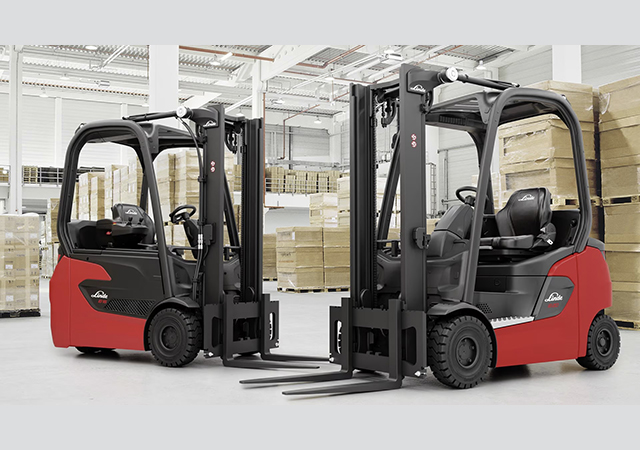






































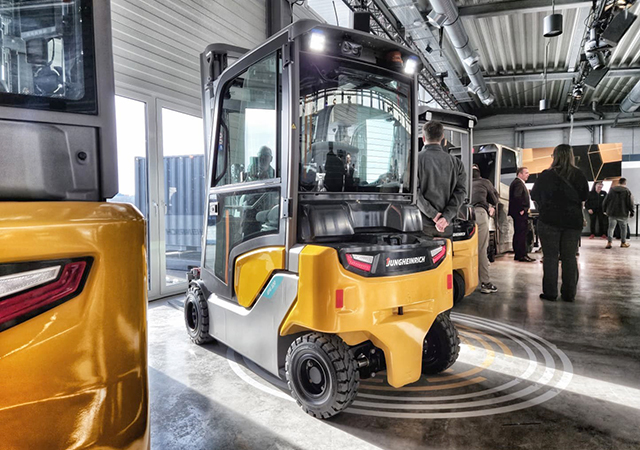
Jungheinrich has completely redesigned the EFG 2/2i and 3/3i series of electric counterbalance trucks in the popular load capacity class up to 2 tonnes, to offer high productivity, safety and future-proofing in a compact vehicle concept.
With the EFG 2/2i series, Jungheinrich offers particularly manoeuvrable three-wheel forklifts with load capacities from 1.4 to 2.0 tonnes, while the EFG 3/3i series covers the range from 1.6 to 2.0 tonnes as four-wheel forklifts.
“With the new series, we have developed vehicles that are consistently geared towards the real requirements in the warehouse – from compactness and ergonomics to performance,” says Marek Scheithauer, Global Portfolio Lead for Counterbalance Light Trucks at Jungheinrich.
A key development goal was to enable customers to use their existing storage space even more efficiently. Thanks to its integrated lithium-ion battery, optimised steering axle geometry and consistently compact design, the new EFG 2/3i models achieve up to 15 per cent better space efficiency, states the manufacturer.
Compared to the previous series, the turning circle has been reduced by up to 300 mm, depending on the model. This enables safe and efficient working in narrow aisles, on truck loading areas or in confined production areas and reduces space costs, it adds.
Three performance variants, modular energy concept
With efficiencyPLUS, drive&liftPLUS and performancePLUS, Jungheinrich offers three clearly differentiated performance levels – from the entry-level variant for moderate handling capacities to a balanced all-round variant and the most powerful configuration for maximum productivity.
In the performancePLUS variant, which is designed for demanding applications and fast goods handling, permanent magnet synchronous motors and optimised hydraulics with improved energy efficiency ensure significantly higher handling performance, says Jungheinrich.
The EFG 2/2i and 3/3i series are based on a modular energy concept. Integrated lithium-ion batteries in various capacities (346, 460 and 690 Ah), tailored precisely to the respective customer requirements, are just as possible as the use of lead-acid batteries or preparation for operation with fuel cells.
Ergonand acoustics for fatigue-free working
The new series has been developed consistently from the driver's point of view. An enlarged footwell with around 100 mm of additional legroom, a lower entry height and an ergonomically optimised steering column reduce physical strain.
A comprehensively revised acoustics and vibration concept with a vibration-decoupled cab ensures a noise level of only 63 dB(A). The new human-machine interface (HMI) with a 4.3-inch touch display and revised controls support intuitive, logical operation and contribute to precise, fatigue-free working.
Greater safety through better visibility
A key safety feature is the newly designed, slanted B-pillar. It reduces the blind spot when reversing by up to 65 per cent, Jungheinrich points out.
A low instrument panel and the optional panoramic roof further improve visibility of the forks, load and rack levels, especially when working at greater lift heights. In addition, a wide range of configurable assistance systems is available, including camera solutions such as the AI-supported addedVIEW person detection system or the zone-based collision protection system zoneCONTROL, it says.
To identify problems early and avoid unplanned downtime, the electric forklifts are networked as standard and provide valuable operating data in real time. Thanks to digital service, predictive maintenance and remote diagnostics, fleets remain in operation longer – with shorter repair times and lower costs.