














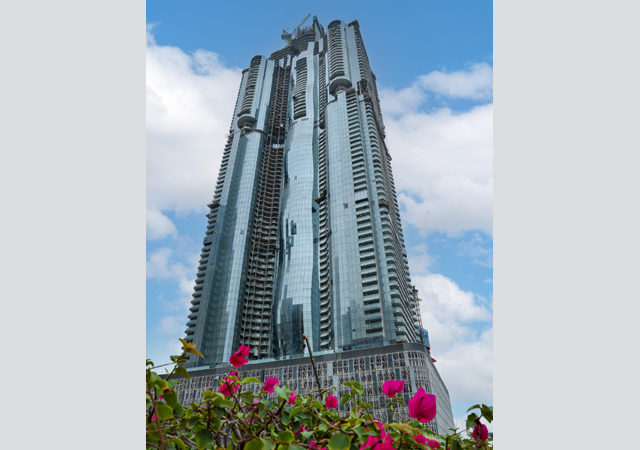
While modern supertall skyscrapers are routinely celebrated for their striking glass shapes, a new residential project dominating the Dubai skyline is shifting the industry’s focus entirely toward structural innovation and sheer operational speed.
Soaring roughly 400 m across 91 storeys, Al Habtoor Tower has successfully moved from a daring blueprint into a masterclass for next-generation vertical engineering. Containing 1,740 residential units within a 370,000-sq-m built-up area, the project stakes claim to being the largest residential building ever constructed, while surpassing traditional global benchmarks in scale, engineering methodology, and structural efficiency.
Building From the Inside Out: The Zero-Demolition Paradigm
The defining technical breakthrough of the Al Habtoor Tower lies beneath the surface, where engineers bypassed conventional high-rise demolition practices. Rather than clearing the site, the project team executed the world’s largest top-down construction sequence over and through live, existing infrastructure.
This approach successfully preserved three basement levels, retaining walls, and foundational assets across 4 million sq ft of built-up area. By avoiding the standard demolition and re-excavation cycle, the development mitigated substantial site risks, lowered baseline material costs, and shaved an estimated 15 to 18 months off the master construction schedule. In an era where urban density and carbon footprints dictate development, this method sets a clear blueprint for sustainable vertical growth.
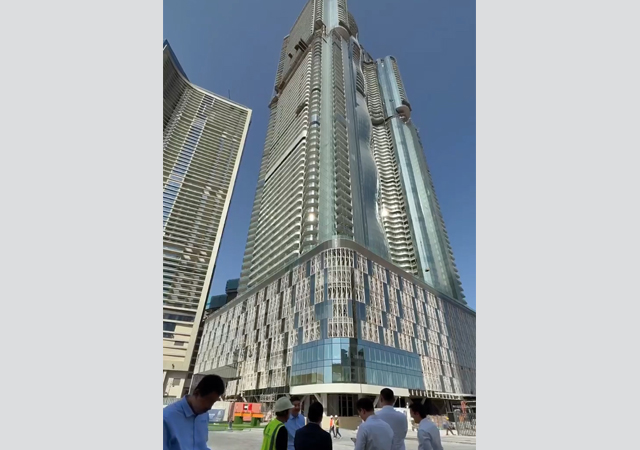
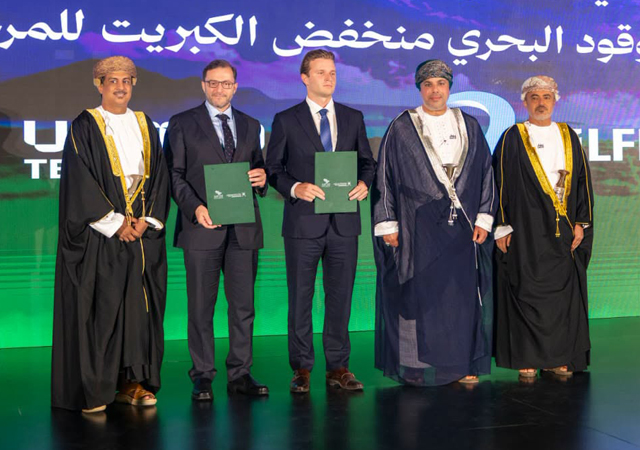
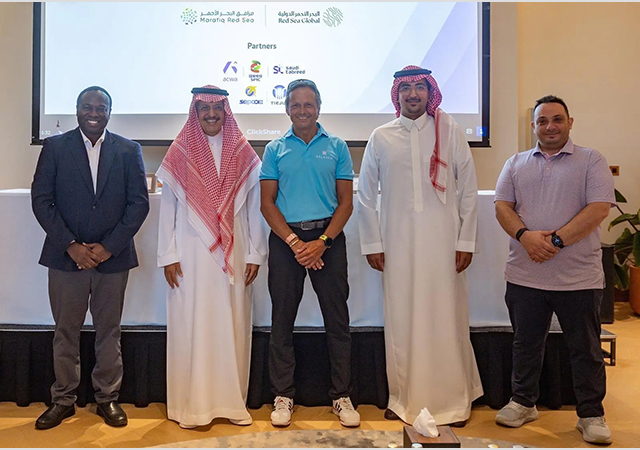
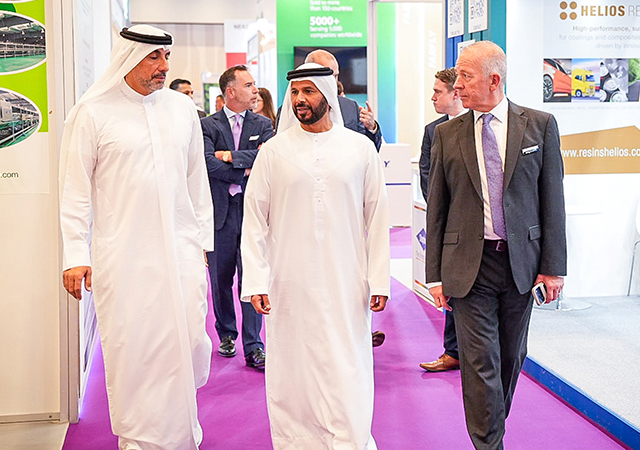
Al Habtoor Group Chairman and other officials at the topping out ceremony of the tower.
Securing the Substructure: Engineering at the Limit
To comfortably anchor the immense vertical weight of a 91-floor tower, engineers deployed a foundation system capable of carrying loads rarely seen in global engineering. The tower is anchored by 96 mega-barrettes that extend to depths approaching 100 m, with each individual barrette engineered to bear a load of up to 22,000 tonnes.
To put that into perspective, the foundational piles of the iconic Burj Khalifa reach down roughly 50 m, while New York’s ultra-luxury Central Park Tower relies on foundation depths of 30 m to 40 m. Punching these deep shafts into the ground required a colossal 300-ton barrette cutter – one of the largest operational units on Earth –paired with a high-performance 110 MPa concrete mix.
The ultimate proof of this foundation’s success lies in its settlement data. Initial mathematical models predicted the tower would settle anywhere between 22 mm and 42 mm. However, real-world laser measurements recorded a physical settlement of just 6 mm, proving a level of structural precision that is incredibly rare for a building of this magnitude, Al Habtoor Group points out.
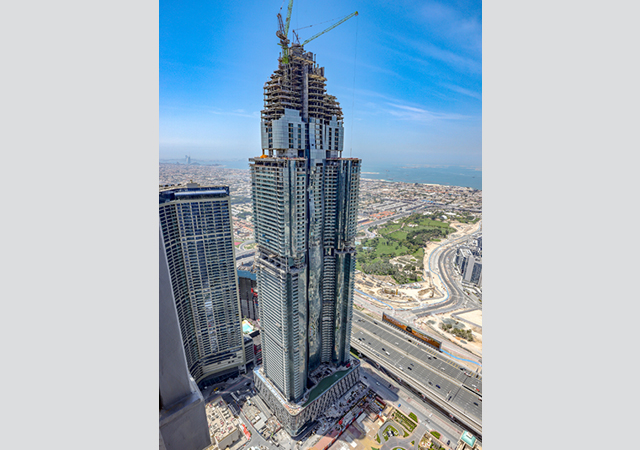
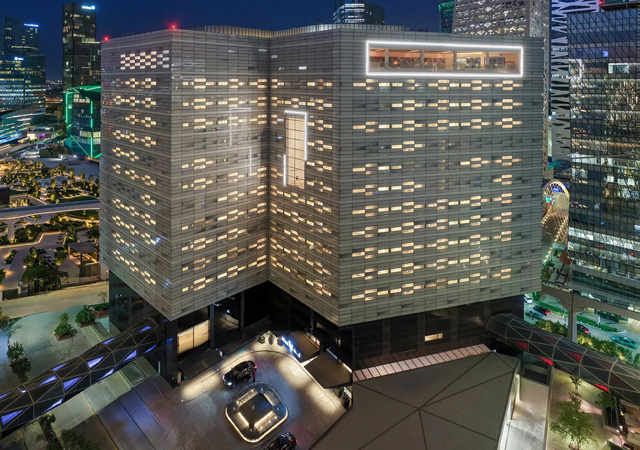
Al Habtoor Tower’s exterior façade integrates over 1,500 private balconies and features decorative, Mashrabiya-inspired podium screening.
Speed at scale
If the sheer scale of the tower showcases architectural ambition, its delivery timeline proves how fast modern construction can move under disciplined management. The entire 400-m tower was structurally completed in just 754 days – roughly two years – marking a daily build rate of approximately 464 sq m.
This pace completely shifts the paradigm for supertall execution. Historical data shows average daily build outputs of 147 sq m for the Burj Khalifa and 64 sq m for the Central Park Tower. Furthermore, famous global supertalls like China’s Shanghai Tower and Seoul’s Lotte World Tower required eight and six years, respectively, to hit completion. The Al Habtoor Tower compressed this timeline by achieving nearly twice the delivery speed of traditional benchmarks without compromising structural or qualitative parameters.
High-Strength Metallurgy and Wind Management
Keeping the tower rock-steady requires a sophisticated hybrid mega-system. The core design relies on a central reinforced concrete mega-core working in absolute lockstep with thick perimeter mega-columns. Heavy structural steel outriggers and strategically positioned belt trusses wrap around the tower at key structural floors to control lateral drift and absorb intense wind loads.
The material choices themselves pushed regional supply chains into new territory. Material specifications were elevated to meet these extreme structural demands. The project marks the first large-scale deployment in Dubai of Grade 600 reinforcement steel, paired with high-strength C90 to C110 concrete mixes and more than 60,000 tonnes of structural steel.
To handle the punishing wind shears and vortex-induced oscillations that hammer buildings at extreme heights, engineers crowned the structure with a specialised porous steel spire system – an aerodynamic solution typically reserved for the world’s most complex architectural geometries.
A Modern Envelope with Deep Heritage Roots
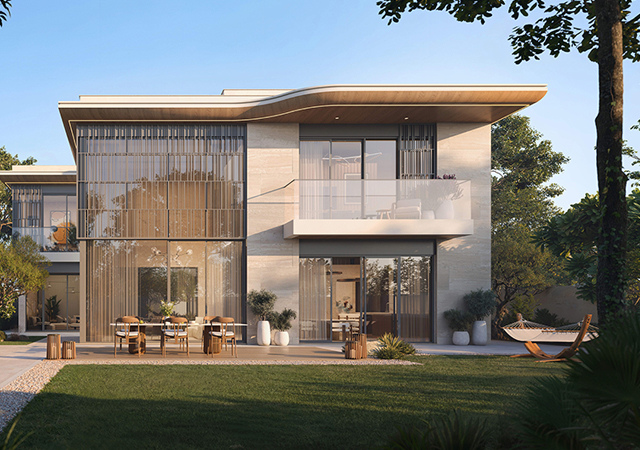
The exterior skin of the building is as massive as its skeleton, featuring a 127,300 sq m total façade area that incorporates a 120,000-sq-m glass curtain-wall. The architectural envelope utilises a dual-tone glazing scheme composed of silver-blue primary surfaces complemented by stone-toned edges, breaking up the vertical massing. The exterior façade integrates over 1,500 private balconies and features decorative, Mashrabiya-inspired podium screening that anchors the modern tower within its regional architectural heritage.
Beyond its structural parameters, the tower reinterprets high-density vertical communities by dedicating 174,000 sq ft to high-end lifestyle amenities. Instead of taking the typical route of clustering communal zones inside the lower podium floors, Al Habtoor Tower distributes them vertically all the way up the building. The layout weaves 65 private sky pools into the floors – with several perched at heights crossing 340 m – alongside dual observation decks on levels 92 and 93, before topping out with a triple-level sky crown designed for hospitality and leisure.
This meticulous balance of engineering discipline and thoughtful design has captured global attention, earning the development multiple top honours at the International Property Awards, including Best Leisure Development (Dubai), Best Residential High-Rise Architecture (Dubai and Arabia), and Best International Residential High-Rise Architecture.
Leadership perspective
Commenting on the project, Founding Chairman of the Al Habtoor Group Khalaf Ahmad Al Habtoor says: “Al Habtoor Tower reflects our commitment to delivering projects of this scale with discipline, speed, and the highest standards of quality. We are proud to see this landmark rise in one of the most prominent locations in Dubai.”
“The UAE, and Dubai in particular, continue to set benchmarks across every sector, from infrastructure to real estate. This project is a direct reflection of that environment. We operate in a market that offers stability, security, and opportunity, and that is why we continue to invest and expand here with full confidence in the future.
“It also demonstrates how we approach development, not only in terms of scale, but in precision, execution, and delivery. Al Habtoor Tower sets a new standard for what can be achieved when engineering ambition is matched by operational discipline,” he adds.
As global construction firms wrestle with shrinking urban footprints, volatile material supply lines, and increasingly compressed development windows, the logistical, material, and structural choices made at Al Habtoor Tower will serve as an industry textbook for years to come. The project stands as proof that the future of supertall development will be won not just by building higher, but by building smarter.