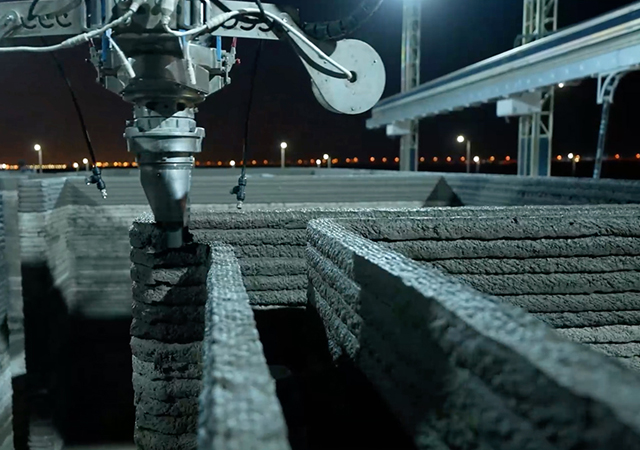

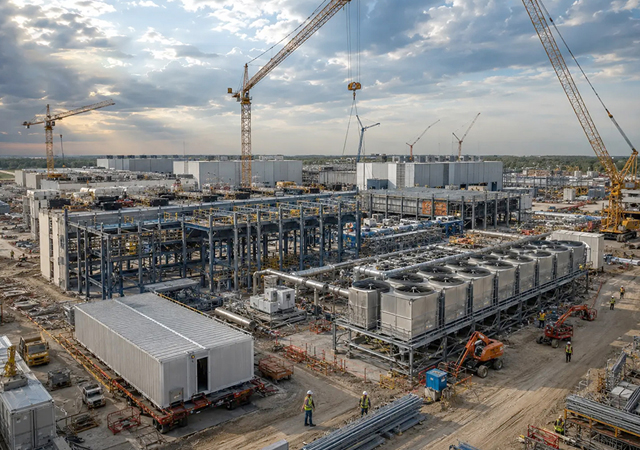













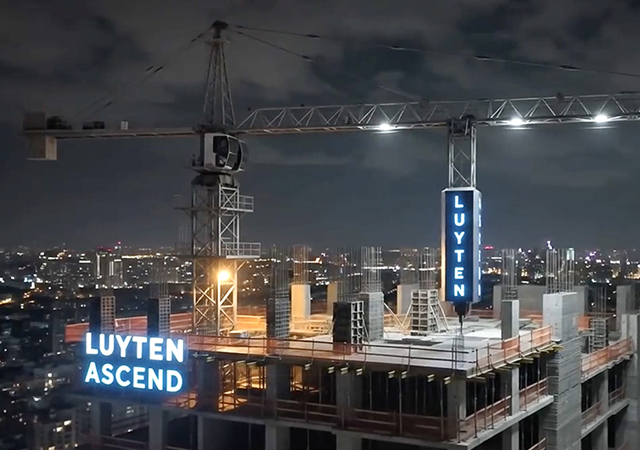
Luyten, an Australian company designing and manufacturing large‑scale construction 3D printers and robotics, has announced the launch of the Ascend Series A27 – a purpose-built tower-crane 3D construction printer that transforms tower cranes into autonomous, high‑reach 3D concrete printing systems capable of building multi‑storey structures up to 100 m in height.
The Ascend Series is Luyten’s next-generation tower crane 3D construction printer developed for multi-storey buildings, high-rise developments, large-scale infrastructure, and advanced construction automation, targeting faster delivery, lower labour dependence and reduced material waste compared with conventional methods.
Unlike conventional gantry-based systems, Ascend combines the reach of a tower crane with large-scale concrete additive manufacturing, enabling automated construction at heights of up to 100 m while maintaining precision, speed, and efficiency.
Ascend converts conventional tower‑crane architecture into an intelligent 3D concrete printing platform, combining crane reach with large‑scale additive manufacturing to enable automated vertical construction at heights previously unreachable by gantry systems, says Luyten.
Ascend integrates robotics, advanced construction automation and tailored concrete printing materials to deliver precision, repeatability and on‑site scalability for developers, contractors and government programs.
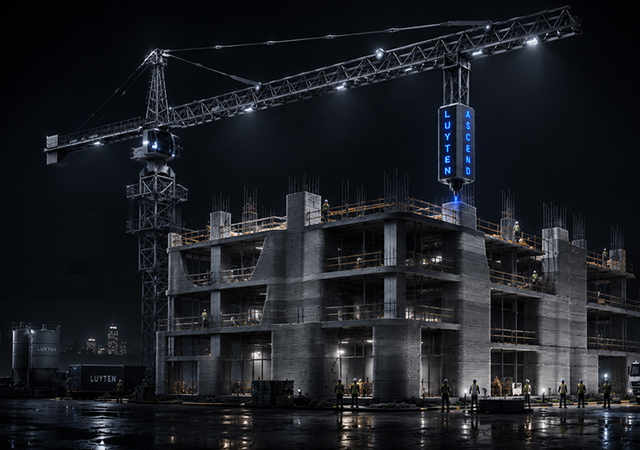
The Ascend Series delivers a 45-m working radius.
The Ascend Series delivers a 45-m working radius, providing large construction coverage from a single installation point and enabling comprehensive building footprint coverage without repositioning.
Rapid deployment is a key advantage, with crane erection and set-up achievable within one to two days, significantly accelerating project timelines compared with gantry-based systems. Advanced AI-driven construction automation powers the platform through sophisticated robotic control systems that optimise construction workflows for precision and repeatability. The automated construction processes substantially reduce labour dependency, minimising reliance on skilled labour while maintaining consistent quality standards.
Ascend integrates with Luyten’s advanced software ecosystem powered by AI-driven construction automation, enabling automated print path generation, construction workflow optimisation, real-time monitoring, and project management integration. The platform is designed for integration with Luyten’s broader product range and digital construction workflows for planning, simulation and on-site control, creating a comprehensive digital construction environment.
The Ascend Series is engineered to operate with Luyten’s proprietary Ultimatecrete printable concrete technology, specifically developed for robotic construction and large-scale additive manufacturing. This system delivers reliable print quality, structural performance, and consistency across demanding construction environments. Ultimatecrete features high-strength printable concrete with superior pumpability and flow control, exceptional layer-to-layer bonding, and optimisation for automated construction workflows that reduce waste and improve material efficiency, according to Luyten.
The platform targets developers and contractors working on multi-storey and high-rise residential and commercial projects, governments and agencies pursuing accelerated delivery of social and infrastructure housing at scale, and research institutions and construction technology partners exploring large-scale additive manufacturing and automation.
Underwater 3D concrete printing
Meanwhile, Luyten said it have achieved a historic milestone in marine construction, in collaboration with researchers from the University of Wollongong (UOW), by creating Australia’s first underwater 3D concrete printing system. It has also introduced a world-first “single-mix” concrete formulation that eliminates the need for chemical accelerators in underwater 3D printing.
The company emphasises that this breakthrough defies conventional wisdom in underwater construction.
“While most global approaches rely on complex systems with multiple stages or rapid-setting chemical accelerators to prevent washout, the joint UOW-Luyten team has developed a unique, accelerator-free mix that stays stable and buildable through smart material design alone,” says a spokesperson for the company.
The technology marks a major step in construction and advanced manufacturing, extending additive manufacturing beyond land applications into underwater environments that have traditionally been difficult, expensive, or unsafe to access.
The underwater 3D printing technology opens a new frontier for defence, ports, coastal infrastructure, and critical maritime assets. It means structures can be built or repaired directly underwater and on-site while greatly reducing the need for costly dry docking, extensive marine works, or long shutdowns, the spokesman adds.
Dr Aziz Ahmed, Project Lead and Senior Lecturer at UOW, says: “To the best of our knowledge, this is the first underwater 3D concrete printing system developed and demonstrated in Australia.
“Our recent trials confirm that our single-mix solution is not just theoretically sound, but practically viable. It offers the structural integrity needed for real-world application while simplifying the logistics of underwater deployment.”
Ahmed Mahil, CEO and Global President of Luyten 3D, comments: “This is a completely new chapter for construction and manufacturing. Printing underwater fundamentally changes how we think about building, repairing, and strengthening critical infrastructure in marine environments.
“We’re moving beyond what’s possible on land. Underwater 3D printing allows us to address infrastructure resilience where it’s needed most, below the surface, whether that’s ports, wharves, defence applications, or other subsea assets.”
“This work is an early rehearsal for extraterrestrial construction. By learning to print in harsh, resource-constrained environments and using in-situ materials rather than refined inputs, we are building the knowledge and technology needed for building on the Moon using lunar regolith as a building material,” he added.