


























Investment in the Middle East data centre construction market is projected to reach $11.39 billion by 2031, transforming the region into a critical hub for artificial intelligence and cloud computing despite recent military escalations that have fundamentally reordered how digital infrastructure risk is priced.
According to a comprehensive industry report released by Arizton Advisory & Intelligence, the regional market is expanding at a compound annual growth rate (CAGR) of 25.79 per cent. This structural buildout is driven by converging forces, rising cloud adoption, AI workload demand, edge computing proliferation, and the push from governments across the GCC to digitalise entire national economies on accelerated timescales. The GCC data centre construction market sits at the epicentre of this expansion, with Saudi Arabia, UAE, Qatar, and Bahrain all running simultaneous, large-scale infrastructure programmes.
Saudi Arabia is projected to hold approximately 35 per cent of regional investment share by 2031, making it the market’s dominant force. The UAE follows, then Turkey, Kuwait, Qatar, Oman, and Bahrain, each at a different stage of maturity but all expanding.
Three structural forces explain why the market is growing as fast as it is, and why that growth was already baked in before the current conflict.
National AI strategy: Saudi Arabia’s National Strategy for Data and Artificial Intelligence, led by the Saudi Data and AI Authority, targets global AI leadership by 2030 through investment incentives, talent development, advanced infrastructure including NEOM, and AI integration across healthcare, education, finance, and government. The UAE’s Digital Government Strategy 2025 and its National Innovation Strategy are pushing cloud, AI, Web 3.0, and Metaverse infrastructure at a comparable pace. In December 2025, Dubai’s leadership held high-level discussions with Elon Musk on AI, space, and digital infrastructure, a signal of how seriously the region treats data infrastructure as geopolitical capital.
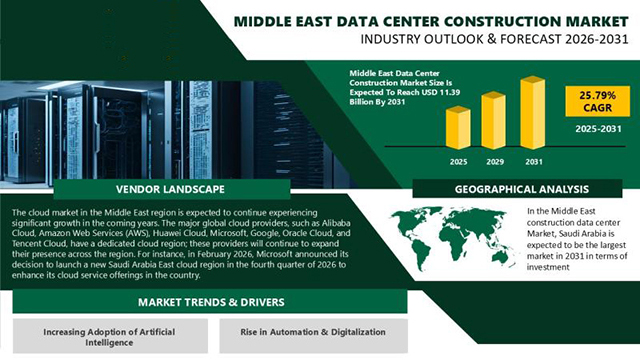
Hyperscaler commitment: AWS, Microsoft Azure, Google Cloud, Oracle, Alibaba Cloud, Huawei Cloud, and Tencent Cloud all operate dedicated cloud regions in the Middle East. In February 2026, Microsoft announced a new Saudi Arabia East cloud region. In December 2025, AWS launched its AI Factory offering, enabling enterprises to run NVIDIA GPUs, Trainium chips, and advanced networking inside their own facilities, extending AI infrastructure demand well beyond public cloud campuses.
AI workload infrastructure: High-density AI compute cannot run on conventional air-cooled rack infrastructure. Across the Middle East, operators are responding with a rapid shift to liquid cooling and immersion cooling architectures.
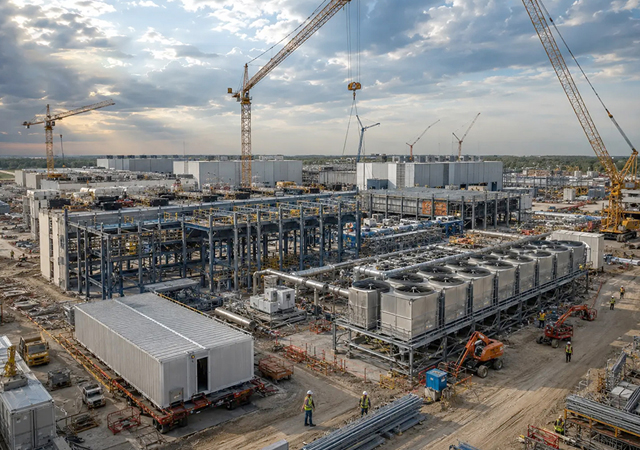
The financial momentum toward the $11.39 billion valuation is further accelerated by a capital-intensive technological overhaul inside the facilities. Conventional air-cooled data centre architectures are proving incapable of supporting the immense heat generated by next-generation AI workloads. As a result, operators across the Middle East are executing a rapid transition to liquid cooling and immersion cooling technologies. Liquid cooling accounted for roughly 41 per cent of total cooling expenditure in 2025 and is forecasted to command a 54 per cent market share by 2031. This shift is typified by developments such as Khazna Data Centers’ recently announced 100-megawatt AI-ready campus near Ankara, designed specifically for high-density compute requirements.
Strategic realignment and sovereign imperatives
However, the growth story is navigating unprecedented operational headwinds. The escalation of the regional conflict saw unprecedented physical disruptions to digital infrastructure, including confirmed missile and drone strikes on Amazon Web Services facilities in the UAE and Bahrain, an Oracle campus in Dubai, and a Pure Data Centres Group site in Abu Dhabi, states the Arizton Advisory & Intelligence report.
The attacks have effectively transformed physical security from a theoretical tail risk into a baseline variable for boardrooms and institutional investors. While the underlying demand for data residency and computing power remains intact, the cost of delivering that capacity is rising, the report stated.
Rather than halting the development pipeline, the heightened risk environment has stratified the Middle East market, forcing a distinct tiering of capital.
Industry analysts note that while some global capital has paused new commitments, sovereign capital and global tech giants are continuing their multi-year deployments. Microsoft remains on track to launch its Saudi Arabia East cloud region by the fourth quarter of 2026, following the late 2025 rollout of AWS’s specialised AI Factory architecture designed for advanced graphics processing units, according to Arizton Advisory & Intelligence.
At the operational level, rising energy prices driven by the conflict’s disruption of nearly 20 per cent of global oil supply routes are increasing data centre operating costs across the region. Supply chain disruptions triggered by the war are extending construction timelines and inflating build costs, making large-scale deployments more complex and more expensive to execute.
At the capital level, the cost of debt and equity for Middle East data centre projects will rise. Investors will demand higher returns to compensate for elevated conflict risk. Insurance premiums for facilities in affected markets are increasing. Stricter due diligence and risk assessment frameworks are becoming standard prerequisites for new capital commitments.
At the strategic level, the conflict is reshaping where new investment flows within the region. Sub-markets perceived as lower-risk, Oman’s Salalah, Turkey’s Ankara corridor, are drawing fresh interest from operators seeking regional exposure without proximity to the primary conflict zones.
Conclusion
What makes the Middle East data centre story genuinely unusual is that neither the growth nor the risk is exaggerated. A 25.79 per cent CAGR through 2031 is real, underwritten by government mandates, hyperscaler commitments, and AI infrastructure economics that have no short-term substitute. Physical attacks on data centres facilities in early 2026 are also real.
The operators and investors who will define the market through 2031 are not the ones choosing between these realities. They are the ones building capital structures, risk frameworks, and infrastructure designs that hold up inside both of them simultaneously, the report concludes.