


























Researchers at Oregon State University (OSU) in the US have developed a quick-setting, sustainable alternative to concrete that could allow for the rapid 3D printing of homes and infrastructure without the heavy carbon footprint of traditional building materials.
The clay-based material, described in the journal Advanced Composites and Hybrid Materials, utilises an acrylamide-based binder that triggers a chemical reaction known as frontal polymerisation. This process allows the mixture to harden as it is extruded from the printer, enabling it to span even unsupported gaps such as window and door frames that typically require structural supports.
Construction already utilises 3D printing to address a global housing crisis driven by a world population nearing 8.5 billion, but the industry faces a significant environmental hurdle. Cement, the primary binder in concrete, is responsible for approximately eight per cent of global carbon dioxide emissions and often requires up to 28 days to reach its full structural strength. Concrete’s curing time and the required structural supports can inhibit progress on construction projects.
The new composite – primarily composed of soil infused with hemp fibres, sand, and biochar, a carbon-rich matter made by heating wood chips and other organic biomass under low oxygen – has a much smaller environmental footprint than that of concrete. Cement is produced from carbon-releasing reactions in industrial kilns heated to more than 1,400 deg C, typically via energy produced by the burning of fossil fuels.
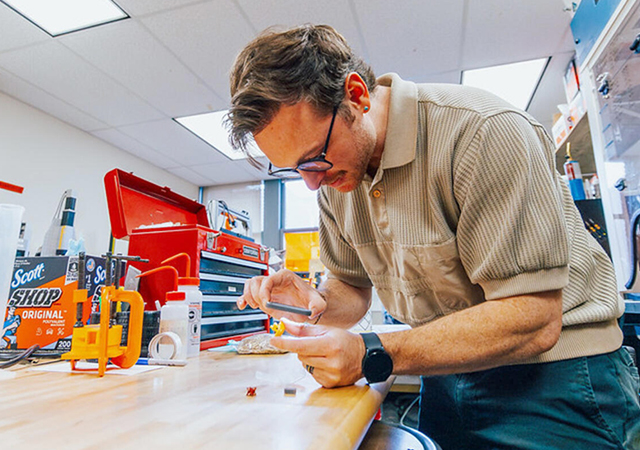
The new clay-based material was developed by Devin Roach, Nicolas Gonsalves and collaborators at Oregon State.
“The printed material has a buildable strength of 3 megapascals immediately after printing, enabling the construction of multilayer walls and freestanding overhangs like roofs,” said Roach, assistant professor of mechanical engineering in the OSU College of Engineering. “It surpasses 17 megapascals, the strength required of residential structural concrete, in just three days, compared to as long as 28 days for traditional cement-based concrete.”
The researchers aim to provide a low-emission solution that can be deployed quickly in the wake of natural disasters. While the material is currently more expensive than standard concrete, the team is working to reduce costs and secure professional engineering approvals through standard testing.
The project, led by doctoral student Gonsalves, received support from the US Department of Agriculture and OSU’s Global Hemp Innovation Center.